Introduction
Website overview
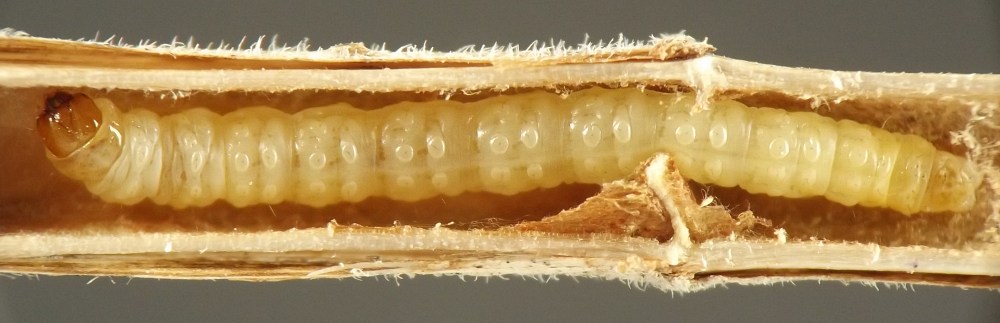
TopOn this website I am publishing the findings from my ongoing, multi-year survey of endophagous insects that feed inside stems and stemlike structures of plants in the Upper Midwest, USA.
By "endophagous insect" I refer to the definition of endophagy in Tooker and Giron (2020). Endophagous insects counted in the survey include any that conduct significant feeding internally in a living plant stem, rachis, peduncle, pedicel, thorn, rhizome, petiole, midrib, or major lateral leaf vein. This includes insects whose initial feeding occurs in the living plant but who complete their development in senescent plant tissue. With a few exceptions, I have generally excluded saprophages who feed only in dead or decaying plant matter. I have also mostly neglected cerambycid, buprestid, and larger lepidopteran borers in woody plants, in favor of focusing on the lesser-known fauna in plant stems, especially herbaceous stems.
All insects were directly observed by me in the Upper Midwest states of Iowa, Minnesota, and/or Wisconsin, mostly between 2010 and 2026. In many cases, my efforts to rear larvae resulted in pupae and/or adults. For nearly every insect record listed on the Browse By Hostplant page, I took photographs of the insect's life stages (including any reared stages) and plant damage and recorded written notes about the same. I am in the process of converting the notes into written descriptions and the photos into internet-optimized versions for publication on this website.
A note on terminology
TopI group endophagous insects from stems and stemlike structures into three broad feeding modes -- borers, miners, and local feeders -- along with a few intermediate categories, and propose the following working definitions. ("Petiole," "rachis," etc. may be substituted for "stem" in the definitions as needed.)
- Local feeding in a plant stem is feeding by an endophagous insect that occurs in a single highly localized and self-contained region within the stem, the region usually less than 1 inch (~25mm) in length and lacking significant directional excavation along the long axis of the stem.
- Stem boring is feeding by an endophagous insect that involves significant directional excavation within the interior or core of the stem, the excavated area usually greater than 1 inch (~25mm) in length.
- Stem mining is feeding by an endophagous insect that involves externally visible, shallow excavation through one or more outer layers of stem tissue.
- A stem borer is an endophagous insect whose feeding activity mostly or entirely involves stem boring.
- A stem miner is an endophagous insect whose feeding activity mostly or entirely involves stem mining.
- A local feeder is an endophagous insect whose feeding activity mostly or entirely involves local feeding.
- A stem miner/borer is an endophagous insect whose feeding activity includes a significant amount of both stem mining and stem boring, generally starting with stem mining and then progressing to stem boring as the insect grows, or whose feeding activity is intermediate between stem mining and stem boring.
- A local feeder/borer in a plant stem is an endophagous insect whose feeding activity includes characteristics of both stem boring and local feeding.
I have been using the term "local feeder" in my private recordkeeping and in certain documents on the website for several years now. It is intended to encompass insects traditionally called "gallmakers", as well as those who can be observed to feed without much excavation in a highly localized region even if it is unclear whether the plant tissue has been modified into a true gall. The idea is to free us (or myself, at least) from the need to define localized feeding based primarily on the physiological modification of the plant tissue, since, in some cases, the details of such modification -- if it has occurred at all -- may only be clearly discernible with high-powered equipment inaccessible to many people. I am considering it beyond the scope of this brief introduction (and my limited knowledge) to discuss the topic further in this report, but for a recent discussion elsewhere on inconspicuous or cryptic galls and related terminology, see Davis et al. (2026).
References
Top- Davis, C.K., Nastasi, L.F., Cuesta-Porta, V., Hines, H.M., and A.R. Deans. 2026. Minimalism is in: two new Diastrophus (Hymenoptera: Cynipidae) species inducing inconspicuous galls on cinquefoils (Rosaceae: Potentilleae), with evaluation of the extended phenotype across gall wasps. Journal of Natural History 60(5–8): 423–447. https://doi.org/10.1080/00222933.2025.2605329
- Tooker, J.F. and D. Giron. 2020. The evolution of endophagy in herbivorous insects. Front. Plant Sci. 11:581816. doi: 10.3389/fpls.2020.581816
Page created: February 12, 2026. Last update: March 5, 2026