Local feeder (Hymenoptera: Eurytomidae) in stems of Ageratina
| Record no.: | 0023 |
|---|---|
| Feeding guild: | Local feeder in stem |
| Taxonomy: | Hymenoptera: Eurytomidae |
| Stages observed: | trace, larva, adult |
| Distribution observed: | IA |
| Hosts in Ageratina: | A. altissima (white snakeroot) |
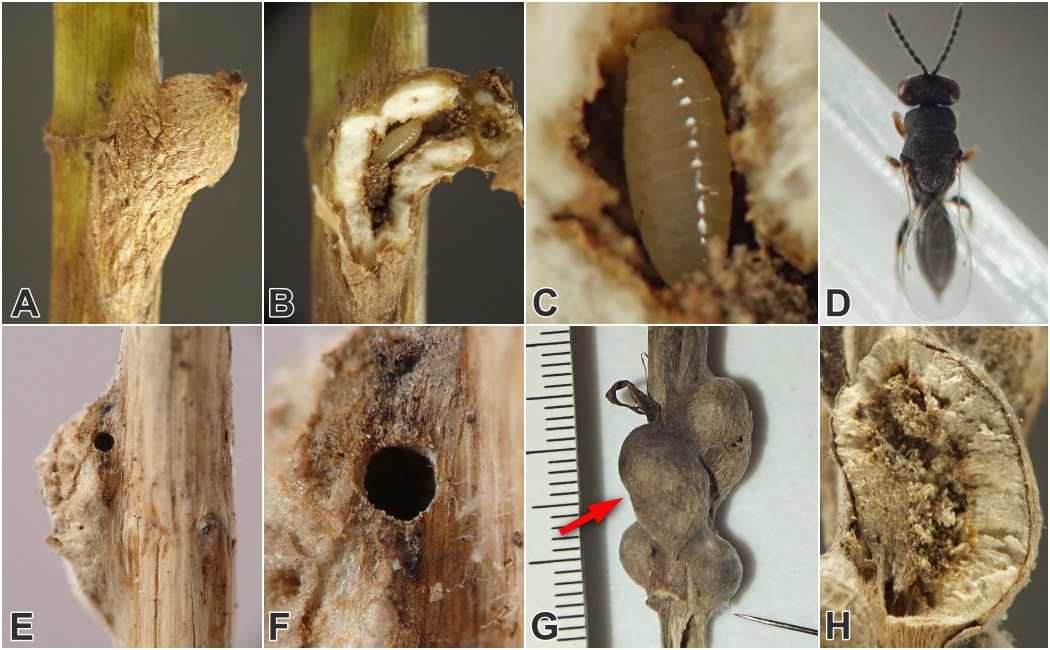
The feeding site of this insect is a subglobular stem gall on white snakeroot. Galls may occur singly or in clusters, and all examples noted have been on the lower stems within ~20cm of the ground. Insects I reared from these galls include a cecidomyiid (cf. Neolasioptera sp.) and these wasps, which belong to the family Eurytomidae as determined by Hill (2023) and Zuparko (2023). The ?Neolasioptera is probably the original gallmaker (see record 0022). However, two galls that produced eurytomid wasps contained solid, rather large-grained frass, which is not typically produced by Neolasiopteras, and the frass had accumulated in a curving tunnel whose diameter seemed too large for a typical Neolasioptera tunnel.
Given these peculiarities, I hypothesize that the wasp may be both a phytophage and an entomophage -- i.e., one of the species of Eurytomidae that is known to feed first on an insect gallmaker and then on the plant tissue inside the gall in order to complete its development. This would explain the situation neatly -- the significantly larger size of the wasp, the accumulations of solid granular frass in the wasp-producing galls, the relatively broad tunnel width inside the wasp-producing galls, and the fact that some galls give rise to ?Neolasiopteras instead. It is also conceivable that, in galls that contain multiple cecidomyiid larvae, the eurytomid larva consumes them all in order to complete its development, accounting for its larger size; in this instance the frass would be a result of the wasp larva excavating the gall interior (but not necessarily consuming the excavated material) in order to reach the multiple cecidomyiid larvae.
For examples of publications citing previously known cases in which a eurytomid has been observed to feed first on an insect gallmaker and then on plant tissue, or to move through a gall and consume multiple gallmaker larvae, see Saghaei et al. (2018) and Noyes (2004).
See also: Ageratina stem insects compilation
 Prev
Prev
- Hill, R. 2023. Comment on contributor post at BugGuide.net. Retrieved November 12, 2023 from https://bugguide.net/node/view/2312449.[return to in-text citation]
- Noyes, J.S. 2004. Notes on families: Eurytomidae. In Universal Chalcidoidea Database. World Wide Web electronic publication. Retrieved November 12, 2023 from https://www.nhm.ac.uk/our-science/data/chalcidoids/eurytomidae.html.[return to in-text citation]
- Saghaei, N., Fallahzadeh, M., and H. Lotfalizadeh. 2018. Annotated catalog of Eurytomidae (Hymenoptera: Chalcidoidea) from Iran. Trans. Amer. Ent. Soc. 144:263-293.[return to in-text citation]
- Zuparko, B. 2023. Comment on contributor post at BugGuide.net. Retrieved November 12, 2023 from https://bugguide.net/node/view/2312446.[return to in-text citation]
Page created: February 9, 2026. Last update: March 30, 2026