Stem borer (Coleoptera) in Alliaria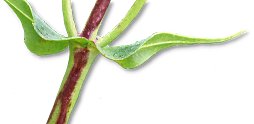
| Record no.: | 0033 |
|---|---|
| Feeding guild: | Stem borer |
| Taxonomy: | Coleoptera: cf. Curculionoidea |
| Stages observed: | trace, larva |
| Distribution observed: | IA |
| Hosts in Alliaria: | A. petiolata (garlic mustard) |
NOTE: An updated version of the following account, along with photographs showing this insect and its plant damage, is available at Some insects associated with weedy non-native and invasive plants.
The main population of garlic mustard examined thus far in the current study supported a large amount of stem herbivory by at least one species of coleopteran borer evidently belonging to the Curculionoidea (based on the larva's general appearance). Larvae tunneled in the stem interiors in spring and early summer, with evidence suggesting there may sometimes be multiple larvae per stem. The tunnels were not externally visible. Some tunnels contained accumulations of solid frass. Even somewhat heavily occupied plants developed seedheads with several pods each.
Blossey et al. (2001, 2002) reported that they observed "stem-mining weevils" (Curculionidae) in their field surveys of garlic mustard herbivores in North America, but they did not furnish a genus- or species-level identification for the weevils. They also did not specify if the weevils' feeding was externally visible in shallow tissues ("true" stem mining as understood in the current study) or out of sight in deeper tissues (stem boring). Blossey et al. (2001) go on to list two weevil species, Ceutorhynchus alliariae and C. roberti, whose larvae "mine stems and leaf petioles" of garlic mustard in Europe, along with other Ceutorhynchus species who are known to feed in petioles, root crowns, and seeds of this host in its native range. Gerber et al. (2008) refer to C. alliariae and C. roberti as stem borers. It is tempting to speculate that a Ceutorhynchus species, either introduced to North America or native and typically found on a native host, may be the borer observed in the current study, but further research would be needed to assess this hypothesis.
- Blossey, B., Nuzzo, V., Hinz, H., and E. Gerber. 2001. Developing biological control of Alliaria petiolata (M. Bieb.) Cavara and Grande (garlic mustard). Natural Areas Journal 21(4): 357–367. [return to in-text citation]
- Blossey, B., Nuzzo, V., Hinz, H., and E. Gerber. 2002. Garlic mustard. Chapter 29 in Van Driesche, R., et al., 2002. Biological control of invasive plants in the eastern United States. USDA Forest Service Publication FHTET-2002-04. 413 pp.
- Gerber, E., Hinz, H.L., and B. Blossey. 2008. Pre-release impact assessment of two stem-boring weevils proposed as biological control agents for Alliaria petiolata. Biological Control 45(3): 360-367.[return to in-text citation]
Page created: February 9, 2026. Last update: August 22, 2026