Stem borer (Coleoptera: Curculionidae) in Asclepias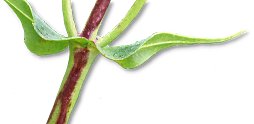
| Record no.: | 0084, 0087 |
|---|---|
| Feeding guild: | Stem borer |
| Taxonomy: | Coleoptera: Curculionidae: Rhyssomatus sp. |
| Stages observed: | trace |
| Distribution observed: | IA |
| Hosts in Asclepias: | A. amplexicaulis (clasping milkweed); A. syriaca (common milkweed) |
I observed sign of milkweed stem weevils in living and dead stems of common milkweed in 2023 and 2025, and I also observed damage to clasping milkweed (A. amplexicaulis) in 2016 that I am tentatively placing here, despite lacking certainty about the culprit.
A dead stem of common milkweed collected in January 2023 contained signs of adult activity and larval feeding from the previous growing season. The stem had a conspicuous, straight and elongate, blackened scar on its exterior that appeared to be the result of numerous holes chewed in a vertical line. Larval excavation in the pithy stem interior was contiguous with this scar and appeared to be limited to the area between two nodes, as was reported for R. lineaticollis by Agrawal (2005) and Nixon (2015).
In early August, 2023, I observed the interior of a stem into which a weevil had oviposited earlier in the summer. The stem had apparently already been evacuated by its weevil larvae. The tunneled area was blackened and contained some dark brown, granular frass along with at least two puparia of a fly, probably Chloropidae (see also below).
Later, in mid-June 2025, I found common milkweed stems in my yard that bore fresh oviposition scars. One such scar consisted of a broad, vertical linear channel cut into the surface of the stem along its long axis, the channel approximately 22mm in length and 3mm wide, with several round pits then gouged through the floor of the channel, arranged in a vertical row and penetrating deeper into the stem. Closer examination of two of these pits revealed a single egg deposited in the bottom of each one. The egg was a pale yellow spheroid, shiny and plump.
Also, in late fall 2025 I opened a few dead stalks of common milkweed that had been damaged by the weevils. In one stem, below the blackened area partly filled with the weevil larvae's frass, there was a stretch of tunnel that had essentially no pith remaining, but which contained several dark red, cylindrical fly puparia, less than 1 cm in length, attached to the inner wall of the stem. These appeared similar to the puparia from the August 2023 collection of live stems. These flies may be a secondary feeder on the weevil frass or (perhaps more likely) weevil-damaged necrotic pith.
Finally, in late June 2016, I noticed wilting stems of A. amplexicaulis in a remnant prairie that had been mostly hollowed out by an insect borer, with a single pale grublike larva found in its tunnel at the base of one of the stems. I did not photograph or examine this larva in detail, so the observation is only tentatively ascribed to Rhyssomatus sp.
- Agrawal, A.A. 2005. Natural selection on common milkweed (Asclepias syriaca) by a community of specialized insect herbivores. Evolutionary Ecology Research 7: 651-667.[return to in-text citation]
- Nixon, P. 2015. Milkweed weevils. In Home, Yard & Garden Pest newsletter, issue 6, June 1, 2015. Retrieved July 2, 2024 from https://hyg.ipm.illinois.edu/article.php?id=693.[return to in-text citation]
Page created: February 10, 2026. Last update: none