Stem borer (Diptera: Agromyzidae) in Amaranthus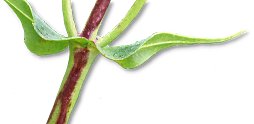
| Record no.: | 0625 |
|---|---|
| Feeding guild: | Stem borer |
| Taxonomy: | Diptera: Agromyzidae |
| Stages observed: | trace, larva, puparium |
| Distribution observed: | IA |
| Hosts in Amaranthus: | A. retroflexus (pigweed) |
I examined an open-grown, highly-branched plant in late August, and found that the stems of two of the side branches each contained a single larva of this borer feeding in its tunnel in the stem interior. I taped the stems back together and held them in a rearing container. Three days later, I observed one of the larvae alive and actively moving at the bottom of the rearing container. When placed briefly on a table surface and held in the palm of a hand, the larva made repeated jumps by hooking its mouthhooks onto the rear part of its body, flexing a bit, then springing away, similar to what I have observed some cecidomyiids doing after evacuating their galls in other hosts. I placed the vaulting larva in a vial of moistened potting mix, and it immediately began burrowing into the substrate, appearing to lead with its posterior end.
In early September I searched the potting mix and found the fly's puparium. Also in early September, I discovered that the second larva had pupated while still inside its tunnel in the stem of its side branch. Both puparia possessed a distinctly wide, hemispherical or dome-shaped anterior end, with the posterior end more slender and tapered but also somewhat rounded. Photos of one of the larvae show what appears to be a set of just 3 bulblike openings on each posterior spiracle, the three openings arranged at 75- to 90-degree angles to one another in the outer half of the circular spiracular area.
In late October, I examined an additional side branch stem from the same plant and found a tunnel in the stem interior, similar in all respects to the tunnels of the first two larvae and leading to a round exit hole in the outer wall of the stem. The tunnel walls were of a brown color, lumpy and irregular with some ragged material left over from feeding. When viewed from the stem exterior, the exit hole was surrounded by an oval ring of light brown necrotic tissue that contrasted with the pale green color of the adjoining healthy tissue, making the exit hole stand out.
Adults did not emerge from the puparia by the end of the growing season, so the puparium is evidently the overwintering stage.
The agromyzid Amauromyza abnormalis has been previously recorded as a stem borer in Amaranthus (Spencer and Steyskal 1986).
- Spencer, K.A., and G.C. Steyskal. 1986. Manual of the Agromyzidae (Díptera) of the United States. U.S. Dept. of Agriculture, Agriculture Handbook No. 638.[return to in-text citation]
Page created: February 9, 2026. Last update: none