Internal feeder (Undetermined) in Artemisia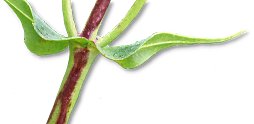
| Record no.: | 0717 |
|---|---|
| Feeding guild: | Internal feeder in stem |
| Taxonomy: | Undetermined |
| Stages observed: | trace |
| Distribution observed: | WI |
| Hosts in Artemisia: | undetermined A. sp., either A. campestris or A. dracunculus |
On June 3, a current-year living stem of the host (tentatively identified as either A. campestris or A. dracunculus) showed at least three holes along its length, opening into chambers or tunnels in the stem interior (whose exact nature I did not record). The holes were neatly round, roughly 2mm in diameter with rather crisp edges, and they were spaced about 40-60mm apart along the length of the stem. I did not observe the culprit, nor discern its feeding mode (stem borer vs. local feeder).
A Papaipema occurs in stems of Artemisia at the same site (record 0081), and given that Papaipema larvae often make frass expulsion holes in the stems they occupy, I could not rule this out as the responsible insect, although the holes appeared more to me like exit holes made by emerging adults of a smaller-sized insect. A large group of Rhopalomyia spp. (Cecidomyiidae) is known from Artemisia spp. (Gagné 1989), but as far as I know none has been recorded as a cryptic local feeder in stems in this manner, and if this were a Rhopalomyia, it would have needed to develop rapidly in elongating, immature stem tissue in order to emerge as adults from current-year stems by early June.
- Gagné, R.J. 1989. The plant-feeding gall midges of North America. Cornell University Press: Ithaca, New York.[return to in-text citation]
Page created: February 10, 2026. Last update: none