Stem borer etc. (Lepidoptera: Gracillariidae) in Quercus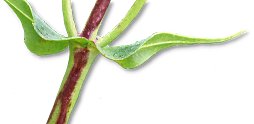
| Record no.: | 0735, 0736 |
|---|---|
| Feeding guild: | Stem borer, midrib borer |
| Taxonomy: | Lepidoptera: Gracillariidae: cf. Neurobathra strigifinitella |
| Stages observed: | trace |
| Distribution observed: | IA |
| Hosts in Quercus: | Q. bicolor (swamp white oak); Q. rubra (red oak) |
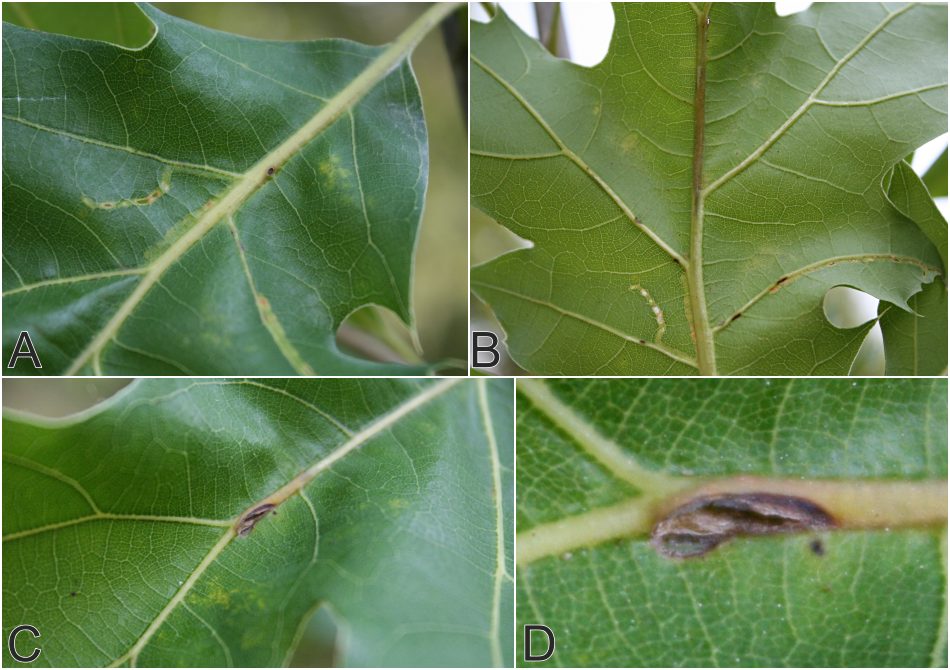
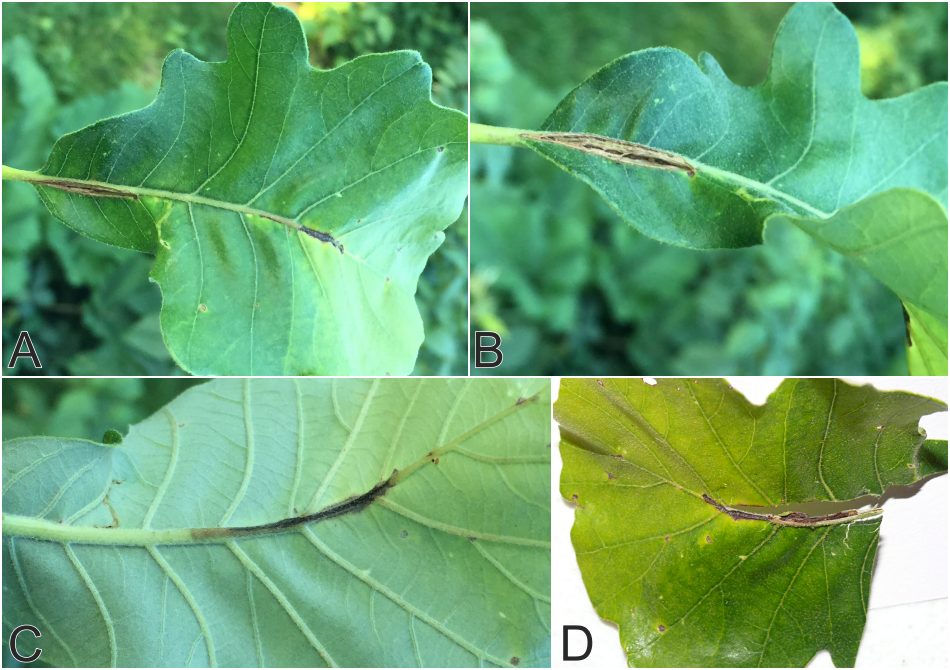
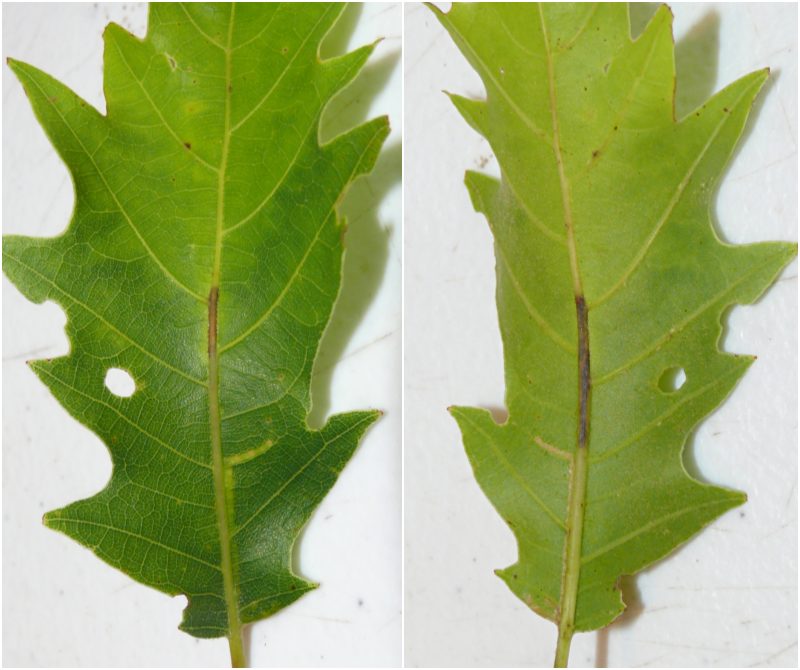
I observed leaf midrib mines in Q. rubra and Q. bicolor, and stem tunnels in Q. rubra. Identification of the midrib mines is based on Eiseman (2025) (pages 1256 and 1347), and the stem feeding is also tentatively referred to N. strigifinitella herein given the similarities to the midrib damage, in some cases with both midrib and stem tunnels having been observed on the same individual tree at the same time. Another researcher, posting to iNaturalist, documented stem tunneling on several oak species in Ohio, and was even able to photograph a live microlepidoptera larva in one of the tunnels (Username bunnymom20 2026). Superficially similar stem tunneling has also been reported on multiple oak species at a nursery in Pennsylvania, causing dieback of terminals (Username m.j.b. 2023).
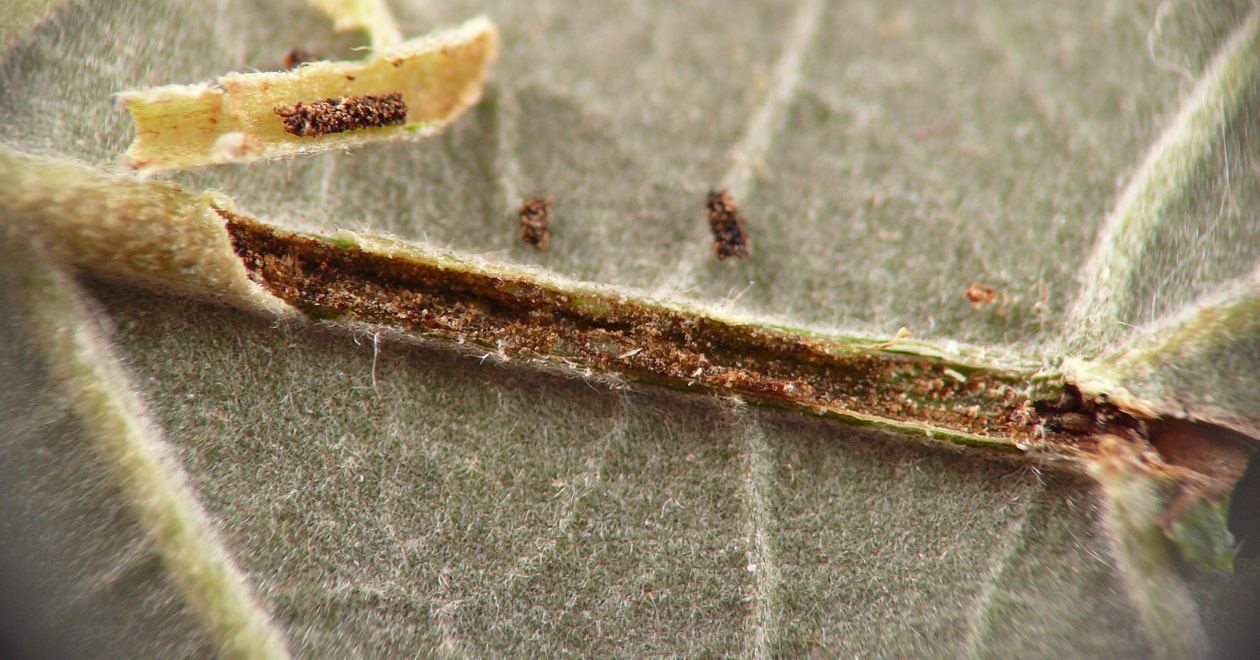
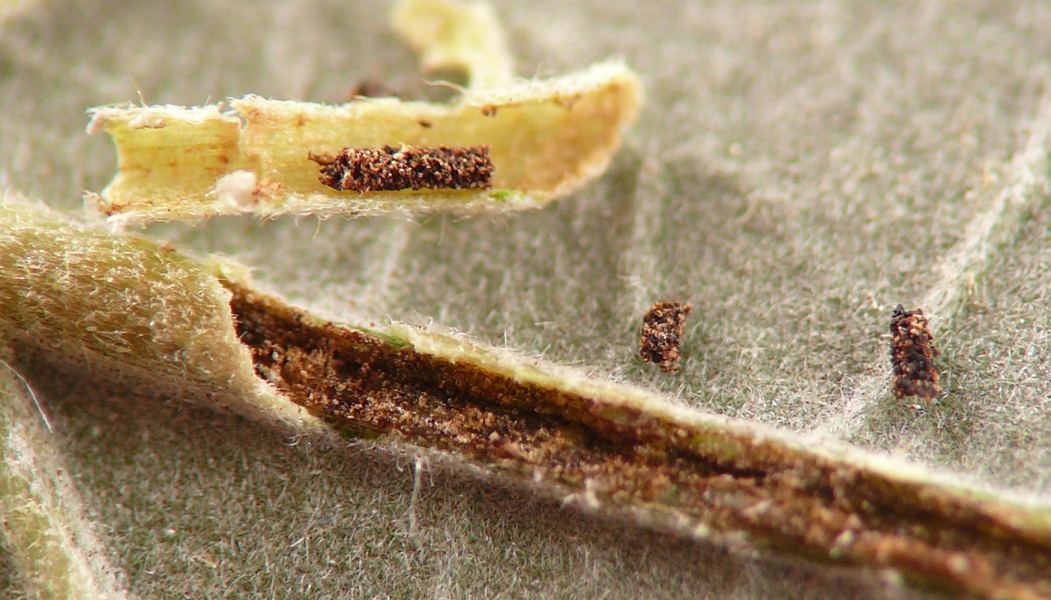
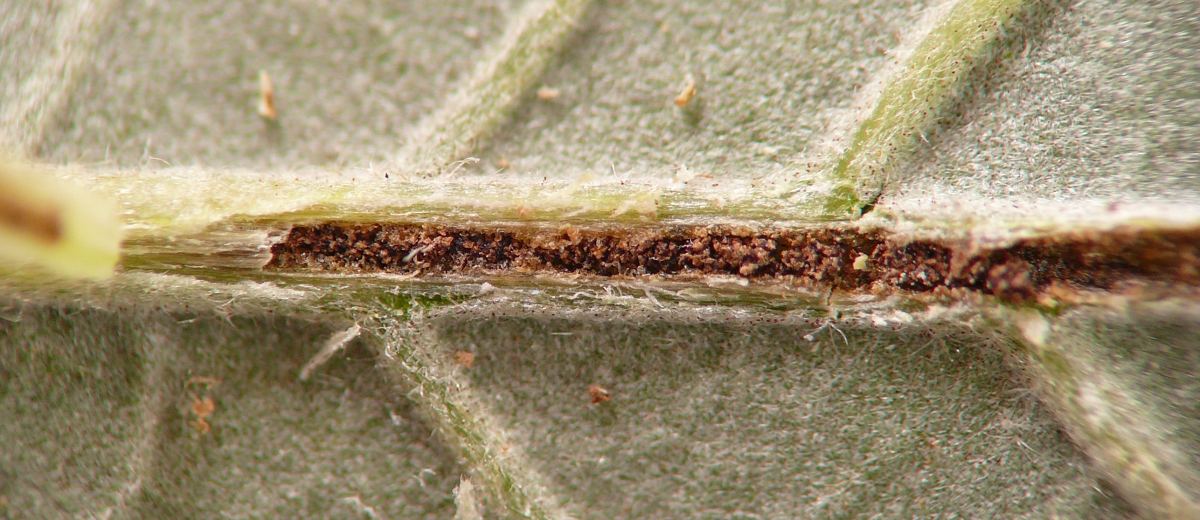
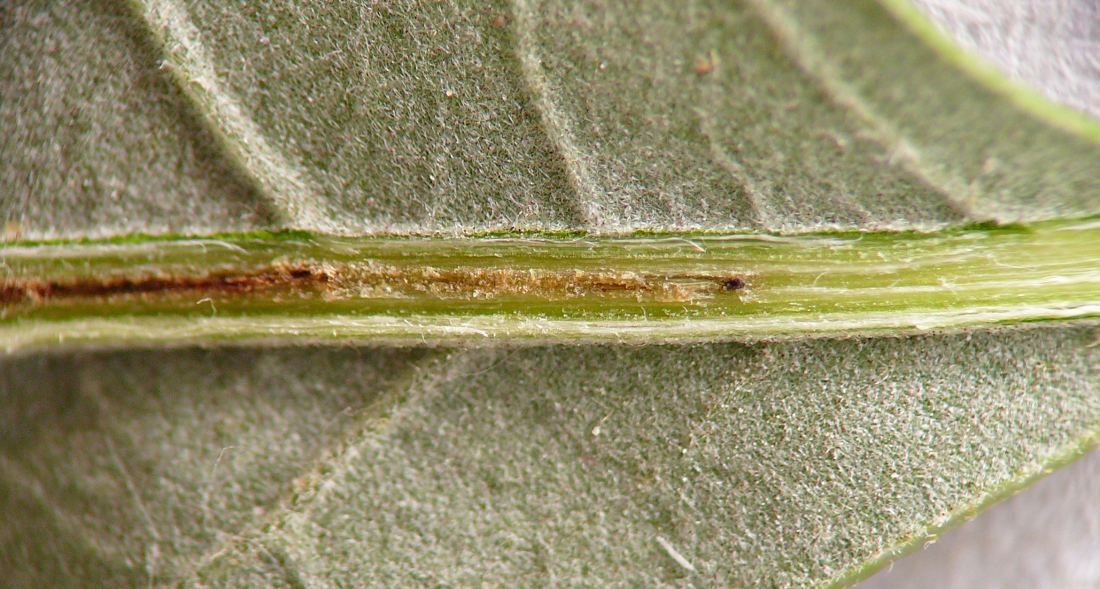
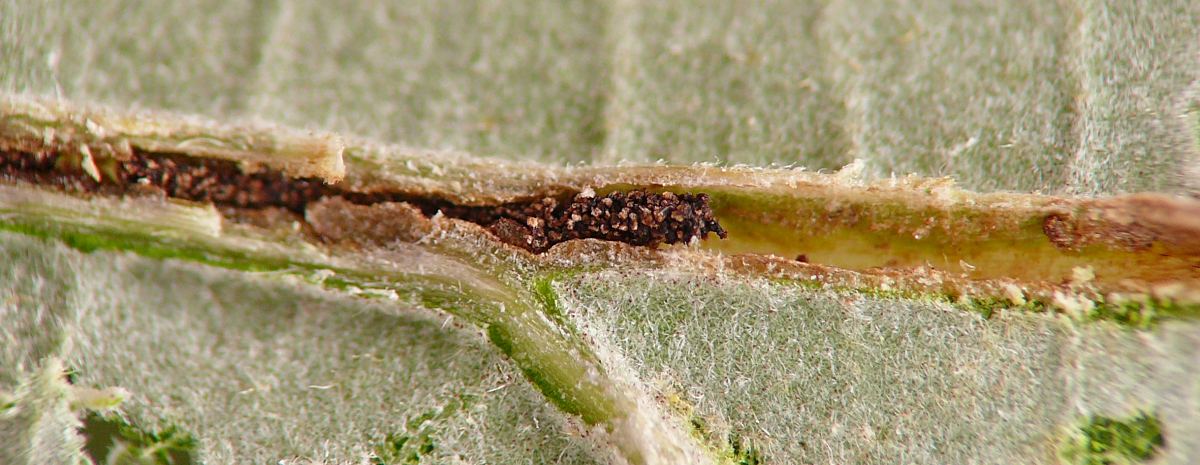
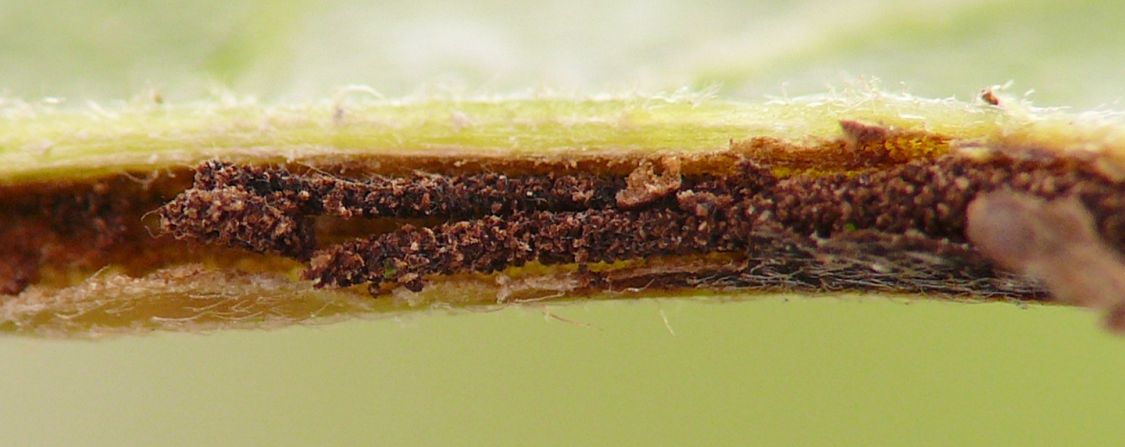
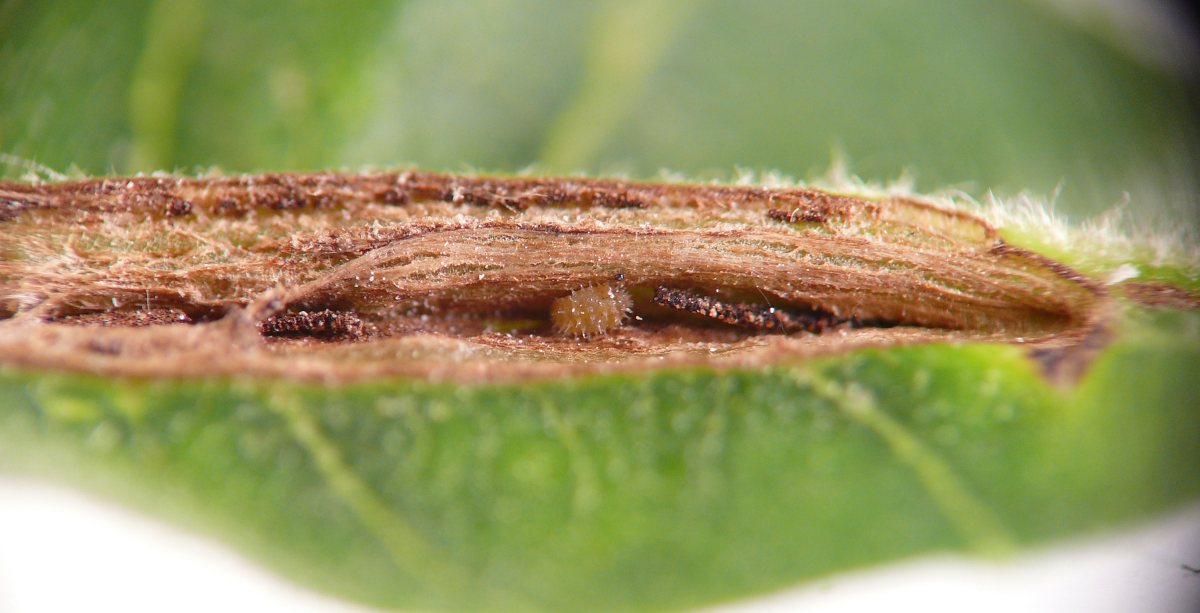
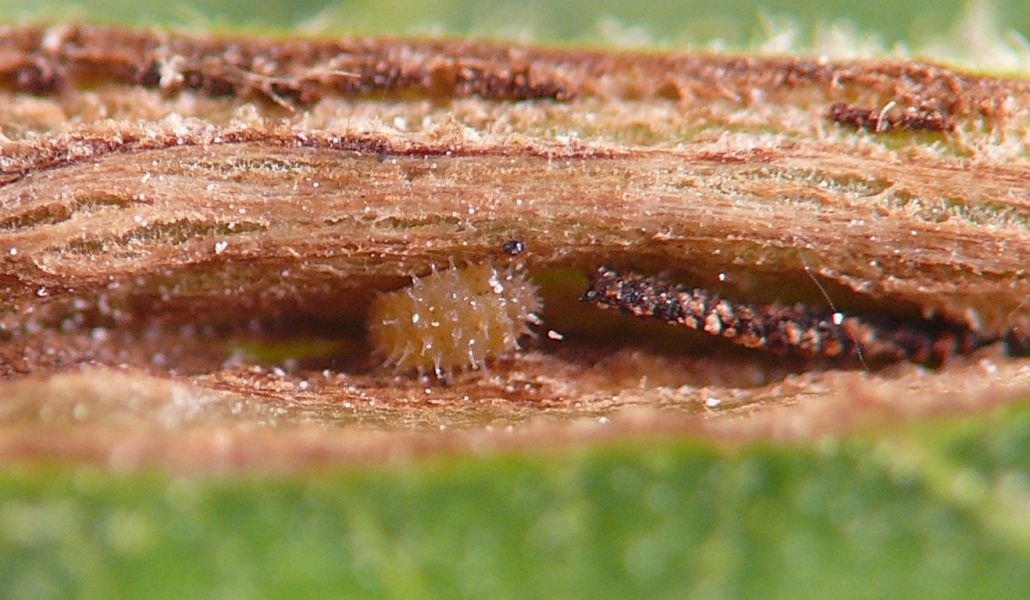
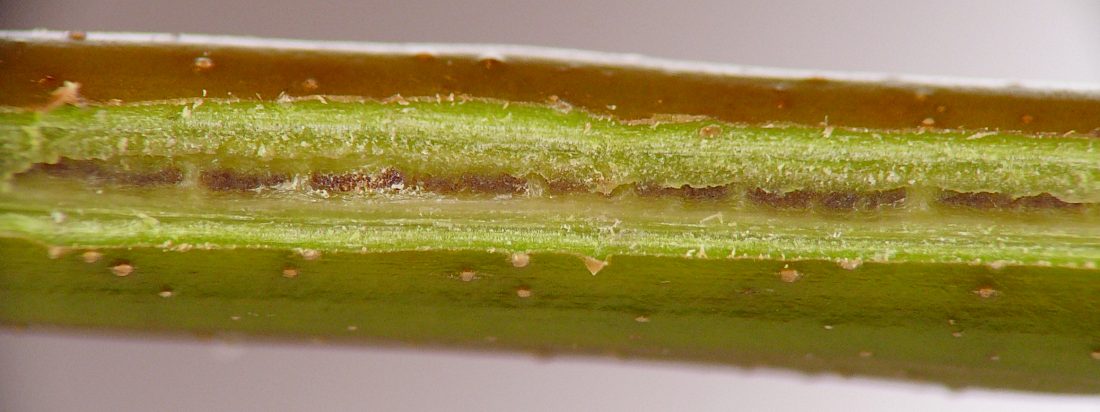
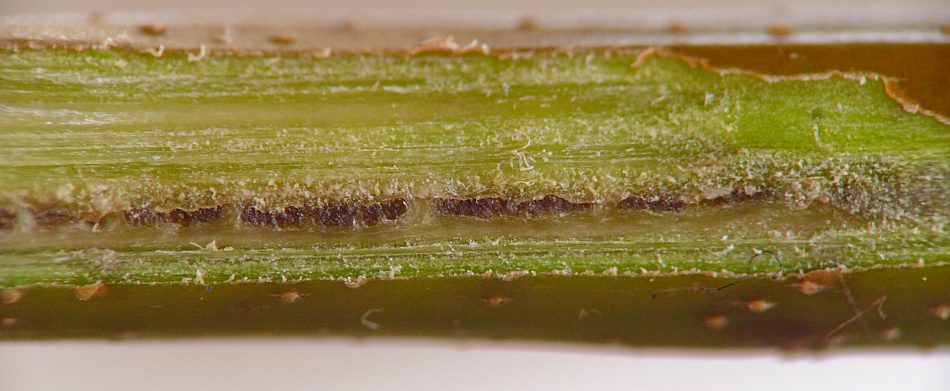
My first observations of N. strigifinitella occurred on Q. bicolor in 2024. Photos 735-03 through 735-11 show one affected leaf, whose midrib had been partly tunneled out and filled with rods of compacted frass. In one stretch of the tunnel, two frass rods were positioned side-by-side, suggesting the larva had excavated twice along this section of midrib (image 735-11). A different, lower portion of the same midrib had split open on the upper side as a result of the larva's internal feeding. The wound had scarred over, and a tiny unidentified insect, perhaps a larva of a coleopteran scavenger, rested on the scar tissue (images 735-09 and 735-10). I would later observe similar unidentified insects (which I sometimes refer to below as "scavenger larvae" for lack of a better term) associated with stem feeding on Q. rubra at the same location (see below).
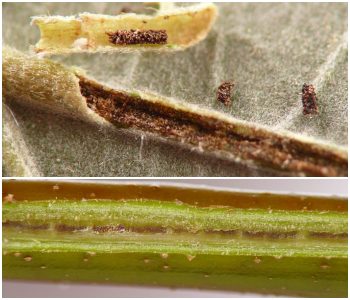
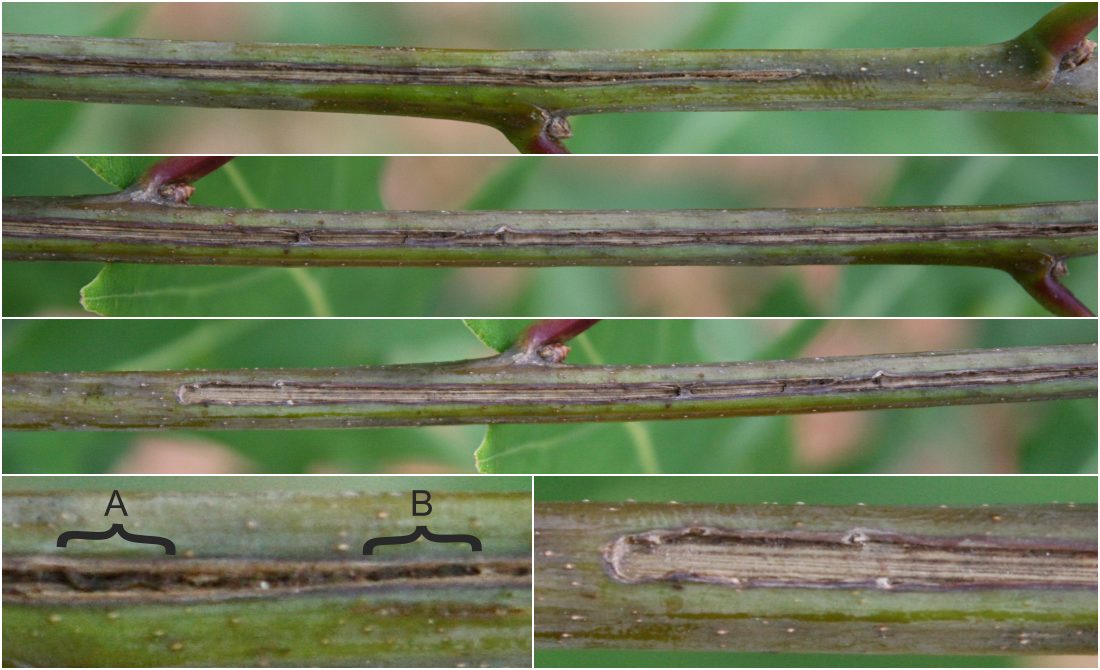
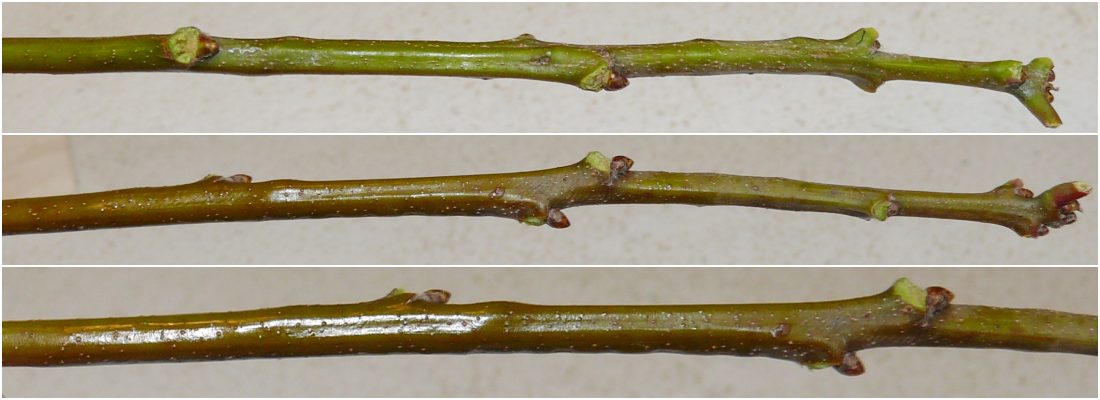
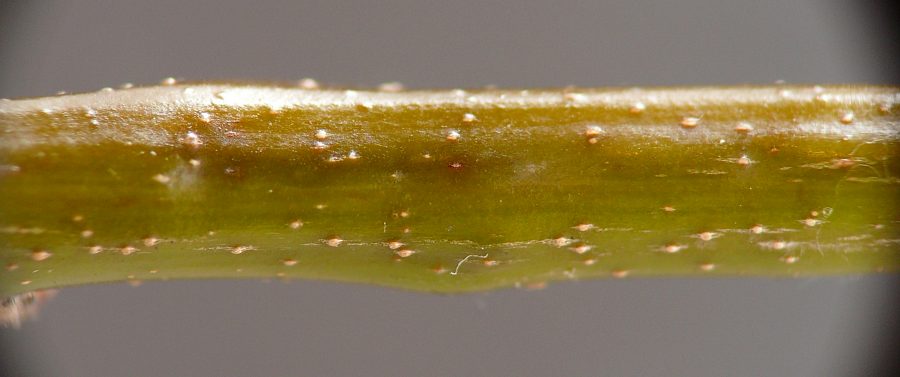
The stem tunnels occurred in two current-year stems I examined in summer 2025, which are shown in images 735-01 and 735-14 through 735-23. The following excerpts from my journal describe what I observed in these two stems, with the corresponding image numbers referenced in brackets.
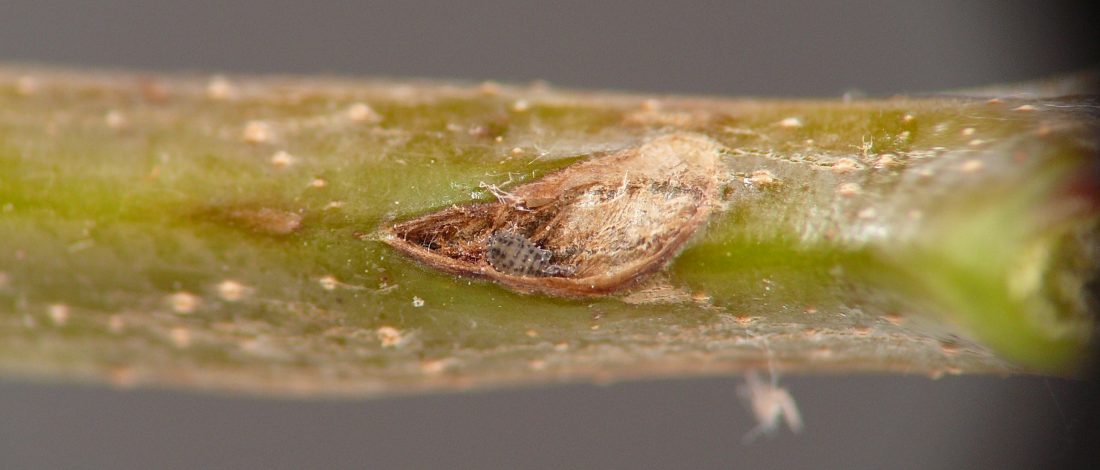
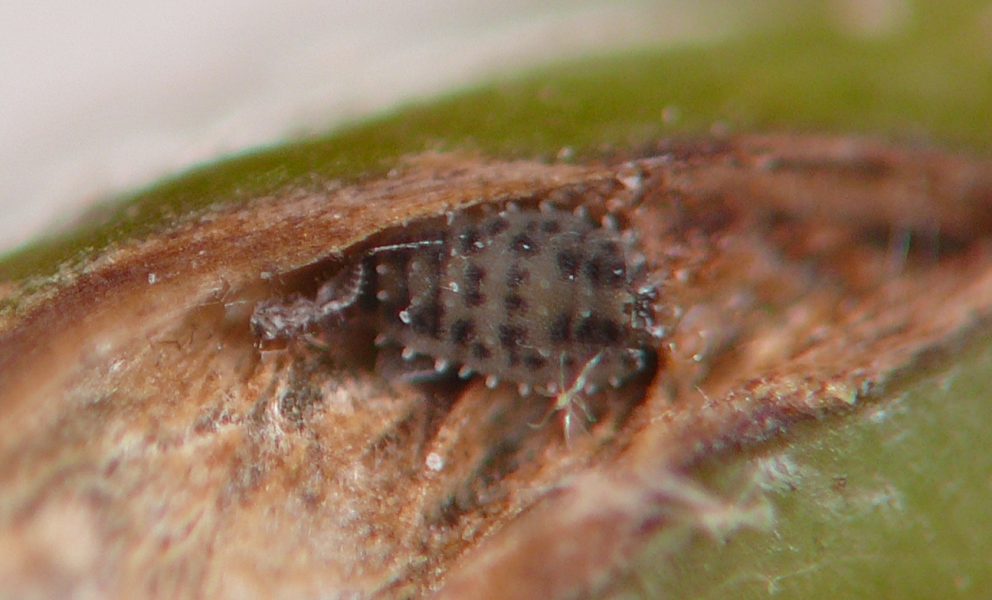
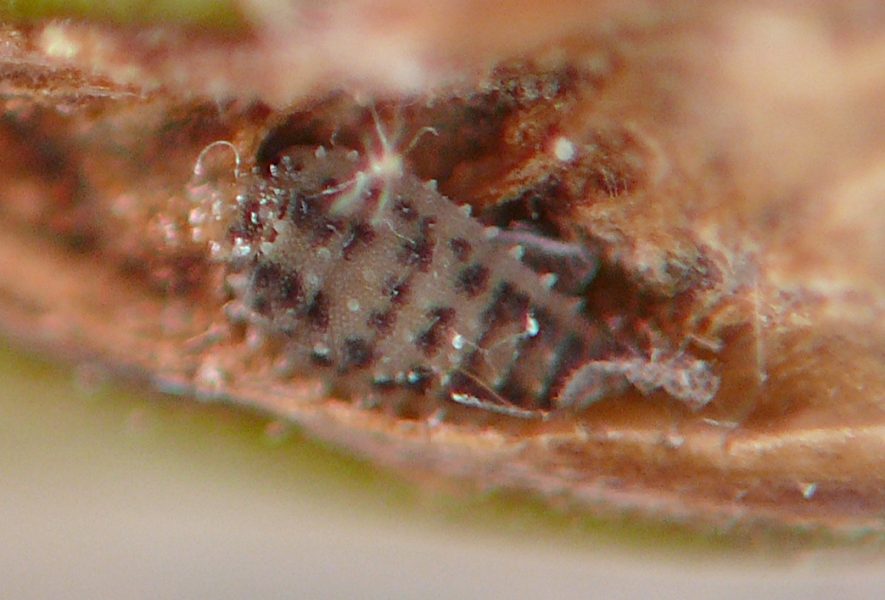
Today (7/26) I also followed up on the red oak sapling. It really looks like something was tunneling shallowly in 2 of the current-year stems, including 1 that I photographed several weeks ago with its apical leaves wilting. I examined that wilting shoot at the time and it did kind of look like there was a little translucence under the epidermis, like something was tunneling in a straight line, but I couldn't be sure. (...) Now that same shoot, "Shoot A", has some lumpiness to it and what looks like some deeper tunneling, faintly externally visible as brownish discoloration in association with the lumpiness...there was also what appeared to be an exit hole in the shoot, more like an exit tunnel, oriented obliquely and facing toward the apical/distal end of the shoot, possibly with a subsurface tunnel leading up to it, and there looked to be a very small beetle (? ) larva inside it, just like the one I found associated with the split-open Neurobathra mine in the swamp white oak leaf midrib/petiole from the yard last summer. [Images 735-14 through 735-18]
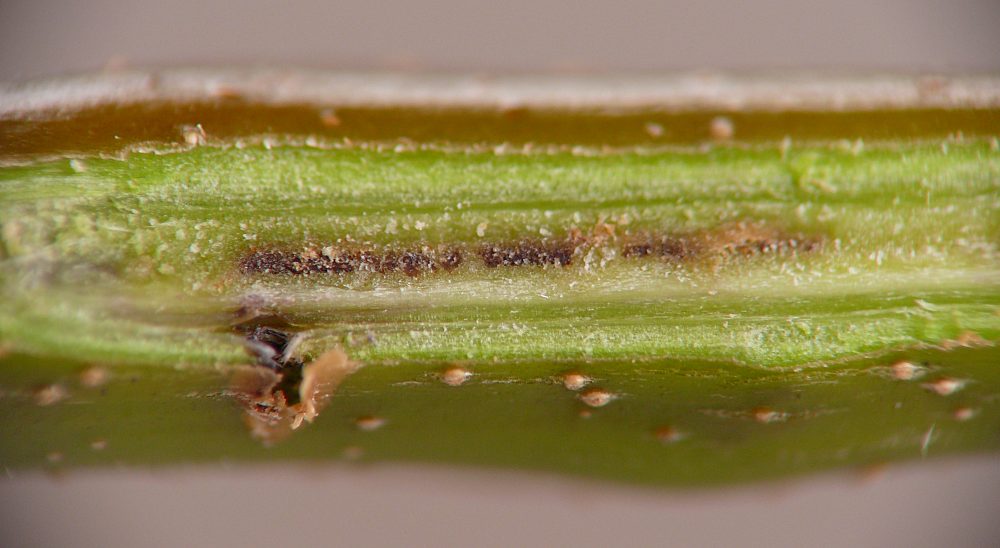
I found many more of these beetle? larvae in the other affected shoot ("Shoot B"), lined up inside a long, straight linear gash in the shoot, probably at least 20-30 cm long, the epidermis having split open; most of the wound was very clean and didn't have much to indicate what caused it but toward the apex of the shoot where the slit was narrower it looked like there might be some Neurobathra-like frass rods assocated with some of the beetle larvae...a brownish line, appearing like a subsurface tunnel, extended for a short distance beyond the uppermost limit of the slit, towards the shoot apex; if I had to guess I would say this is part of the tunnel that didn't split open, and it is probably filled with a frass rod. The opposite end of the slit, much closer to the proximal end of the shoot, ended in a neatly rounded semicircle, as if it were an exit slit whose operculum had been destroyed when the mine split open. [Image 735-01]
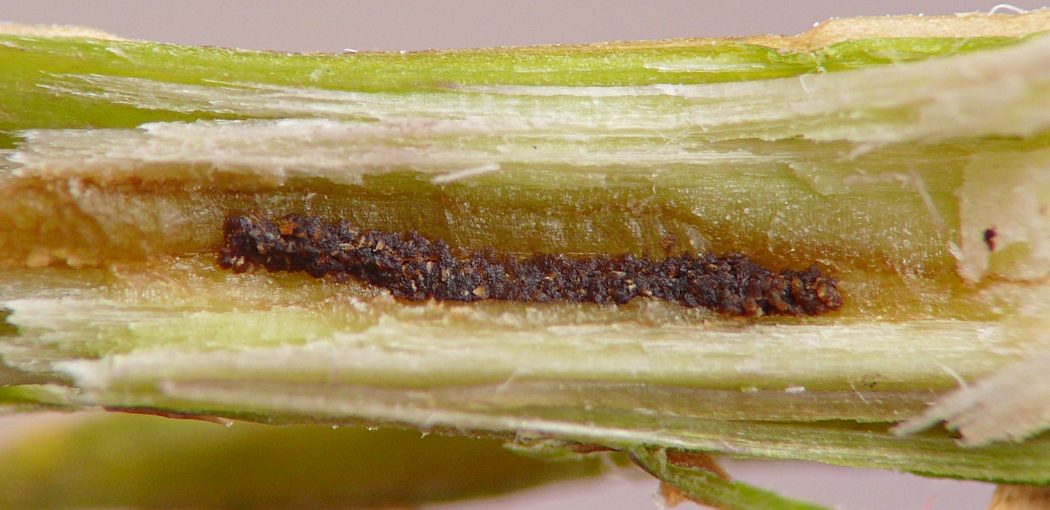
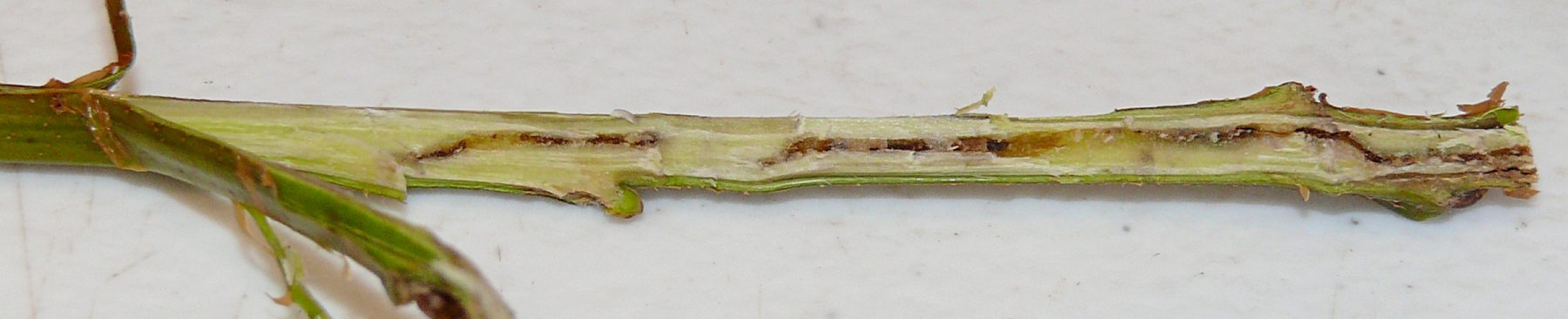
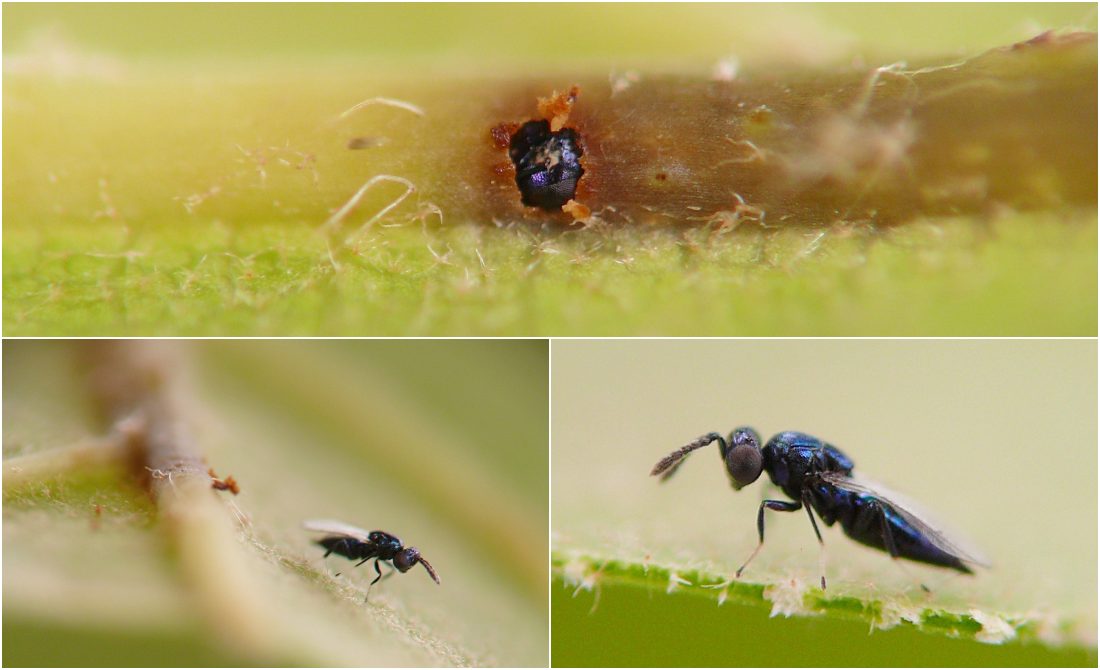
I harvested "Shoot A" and held it in a rearing container for several days, after which I dissected it on or about 08/01/15, confirming the hypothesis of deeper subsurface tunneling (images 735-19 through 735-23). Also on 08/01 I examined a leaf on the shoot containing a parasitized N. strigifinitella mine from which the adult parasitoid was actively emerging:
...[O]ne of the smaller leaves had something indistinct but minelike in the blade near the base, up against midrib and veins, and a maybe 2.5-3 cm long area of the midrib that had obviously been tunneled, AND there was a little dark head partly poking out of a hole on one end of the tunneled area in the midrib, which...turned out to be a iridescent blue parasitoid wasp working on its exit hole. [Images 735-12 and 735-13]
On the same tree, I recorded details about the apparent larval exit slit in another leaf midrib mined by N. strigifinitella:
On [~08/01/25] I was examining the same red oak (Quercus rubra) tree having Shoots A&B...when I found an apparent mine of Neurobathra strigfinitella on an upper leaf of the sapling. There was an obvious tunneled area in the midrib of this large leaf, the tunneled area appearing more extensive than the one on the smaller leaf from which the parasitoid emerged in the lab. (...) I happened to glance at the upperside of the leaf and there was an obvious exit slit / hole in the midrib on the upperside. It was the SPITTING IMAGE of the exit slit / hole on Shoot A...scarred over, oblique-looking like it was cut at an angle, kind of with a little "welcome mat" or tongue welcoming the newly emerged larva into the outside world. [Image 735-02]
Taken together, these observations suggest N. strigifinitella and/or another micromoth feed in both midribs and stems of Quercus in the study area, creating long linear tunnels filled with rods of compacted frass. Combined with the aforementioned observations shared by other workers on iNaturalist and BugGuide, it appears that the stem damage is occurring at several locations widely distributed across the central and eastern U.S. Some of the midrib and stem excavations are shallow enough that the roof of the tunnel may collapse or split (presumably after the larva has exited the plant), resulting in linear exposed scars running along the length of the plant tissue, and shoot dieback may also occur (as cited above). The stem feeding deserves further study in order to better establish the identity of the insect(s) involved. It would also be helpful to identify the mysterious scavenger larvae associated with the midrib and stem tunnels.
 Prev
Prev
- Eiseman, C.S. 2025. Leafminers of North America, 3rd edition. Self-published e-book. Available from the author at https://charleyeiseman.com/leafminers/.[return to in-text citation]
- Username bunnymom20. 2026. Observations [with filters "Description / Tags" = "neurobathra strigifinitella" and "Person" = "bunnymom20"]. Contributor posts on iNaturalist.org. Retrieved July 24, 2026 from https://www.inaturalist.org/observations?q=neurobathra%20strigifinitella&user_id=bunnymom20&verifiable=any.[return to in-text citation]
- Username m.j.b. 2023. Oak leafminer/shoot dieback. Contributor post on BugGuide.net. Retrieved July 24, 2026 from https://www.bugguide.net/node/view/2275509.[return to in-text citation]
Page created: July 24, 2026. Last update: July 24, 2026